
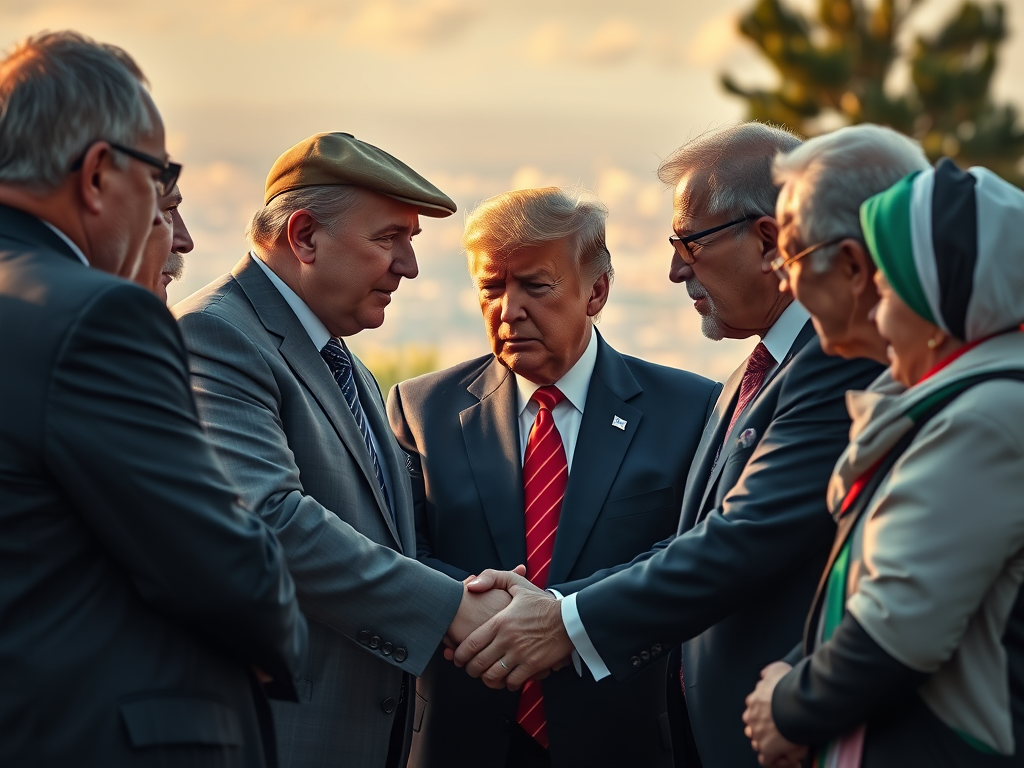
The guns are finally quieting. A U.S.-brokered ceasefire is being implemented, and the first hostages have begun to come home while Israel prepares mass prisoner releases. President Donald Trump has flown into the region to sell a 20-point post-war framework and to co-chair a summit aimed at locking in a longer peace. Those are facts. Whether he “stopped” the war—and whether he deserves credit—is more complicated.
What happened—and what it means
Trump’s team helped push a deal that exchanges living hostages and the remains of others for nearly 2,000 Palestinian detainees, opens Gaza to large-scale aid, and sets up a political track for Gaza’s governance. Netanyahu has publicly aligned with key elements of Washington’s plan, even as questions remain about Hamas’s buy-in and the durability of the truce.
In short: the U.S. pushed; Israel moved; Hamas yielded on some points; and a ceasefire took hold. That is nontrivial statecraft. But the war’s end comes after two years of devastation—tens of thousands of Palestinians killed, most Gazans displaced, and Israeli society traumatized—facts that no diplomatic victory lap can erase. Credit, if any, should be apportioned with humility and a long memory.
The “America First” contradiction
Trump campaigned (again) on “America First”: fewer costly entanglements, more transactional leverage. Critics ask how to credit him abroad while his economic choices at home—especially broad tariffs—have weighed on prices and sentiment. The data are mixed: growth rebounded to a 3.8% annualized pace in Q2 2025 after a contraction in Q1, while inflation remains near 3% and consumer sentiment is historically weak.
That picture doesn’t prove “economic destruction,” but it does show a country feeling squeezed even as headline growth recovered—a political backdrop that makes any overseas triumph look self-serving to skeptics.
Motives: compassion—or legacy and ego?
Foreign policy is never pure. The White House touts a humanitarian surge and an end to hostilities; regional experts note months of pressure, shuttle diplomacy, and hard leverage on Jerusalem and Arab capitals. Trump personally declared “the war is over” while racing to appear in the region for the rollout—precisely the kind of optics that feed a legacy-minded narrative.
Real people benefit if the ceasefire holds; real politics accompany the choreography. Both things can be true.
Does Trump deserve credit?
Some, yes—conditional and shared. The administration’s pressure and proposal were pivotal in finally aligning moving parts that had repeatedly failed to align. But credit is collective (Egypt, Qatar, Israel’s war cabinet, Palestinian intermediaries, the ICRC) and contingent on what follows: full hostage returns, sustained aid, reconstruction, credible civilian governance, and accountability for wartime conduct.
If the ceasefire falters, today’s credit evaporates tomorrow.
The domestic ledger still matters
Americans will judge any foreign-policy “win” through the kitchen-table lens. With inflation near 3%, persistent tariff-driven price pressures, and sentiment stuck in the mid-50s, many households don’t feel better off. A president trumpeting peace abroad while many feel squeezed at home will face skepticism about priorities and motives. That skepticism doesn’t negate the diplomatic outcome; it limits its political yield.
The right way to give credit
- Acknowledge the outcome, not the myth. Say the U.S. helped assemble a ceasefire and a roadmap—not that one man “ended a war.”
- Keep receipts. Insist on timelines for aid corridors, prisoner exchanges, and governance milestones; judge performance, not press releases.
- Center civilians. Credit is proportional to how quickly lives improve—food, water, power, security, and freedom from bombardment and rocket fire.
- Demand transparency. If reconstruction turns into patronage, or if displacement becomes de facto expulsion, withhold the laurels.
Bottom line
Give Trump qualified credit for helping midwife a ceasefire and a political track at this late hour, while recognizing two truths:
(1) The war’s scale makes celebration indecent without rapid, measurable relief; and
(2) The administration’s domestic record—economy, polarization—colors public judgment of any foreign-policy win.
Applaud the result; scrutinize the motives; verify the follow-through. Only then will credit be earned rather than claimed.
Leave a Reply