
EAU CLAIRE, Wisconsin — In this rural-heavy stretch of the upper Midwest, Democrats are trying to claw back districts where their party brand is still deeply toxic.
It won’t be easy, even in a midterm environment that heavily favors their party. Local Democratic organizers in western Wisconsin, where Rebecca Cooke is trying to oust GOP Rep. Derrick Van Orden, know that elections here are decided by the slimmest of margins. They have no room for error.
“Everything’s on a razor’s edge,” Clara Serrano, who volunteers for the local Democratic Party, said as she drove along farms and cornfields outside Eau Claire.
But a decade after President Donald Trump’s populism and culture wars swung the formerly Democratic-leaning region right, many voters from western Wisconsin over to southern Minnesota and down to eastern Iowa are hurting — and blame the president’s policies. Family farms are reeling from his tariffs. Diesel is over $6 a gallon. The cost of fertilizer has shot up more than 30 percent since the war in Iran began earlier this year.
“[Rural voters are] mad when we get to the door — and not at us,” said William Garcia, co-chair of the La Crosse County Democratic Party who has been out canvassing. “They’re mad about gas prices. They’re mad about fertilizer. They’re mad about the tariffs. And so all we do as Democrats is say, ‘Hey, we agree. We rejected all of these things. We’ve been fighting all of these things.’ So it’s much more receptive now than really it’s ever been.”

Local Democrats have pulled out all the stops to propel Cooke in Wisconsin’s 3rd District, knocking endless doors in redder areas. There have been national reinforcements as well: Populist Sen. Bernie Sanders (I-Vt.) endorsed Cooke during the primary and hit the campaign trail with her this week in Eau Claire. The national party is trying to make generational gains in Minnesota’s 1st District — where they’re hoping to pull off a major upset to unseat GOP Rep. Brad Finstad in a Trump +12 district — and in deep-red Iowa, where Democrats are targeting three GOP House seats, a Senate seat and the governorship.
Democrats for years have faltered with rural voters in these districts. Now, with polling showing Democrats gaining ground in redder territory and an electorate that’s souring on the GOP, Democrats hope they can finally make up ground this November — and lay a solid foundation for the 2028 presidential election.
If that doesn’t happen, it’s an ominous sign for the party.
“If we can’t win these seats now in this environment, it seems like we’re in for a world of hurt in 2028,” said one House Democrat, who, like others in this article, was granted anonymity to speak candidly.
Wisconsin Democrats have worked nearly-year round to build up a ground game. A major new initiative from the state party has helped to boost organizing, especially in rural counties and other places they’ve struggled.
“We haven’t really stopped organizing since 2024,” said Pete Huff, co-chair of the nearby Dunn County Democratic party, where Trump won by 16 points.
Cooke, who grew up on a farm in the area, has tried to create a more durable brand of politics in the district by largely trying to distance herself from the national Democratic party as she seeks to win over a broader base of voters. It helped in 2024: She overperformed Kamala Harris by 9,000 votes across the district, even though she narrowly lost to Van Orden.
“I think that the party doesn’t know how to speak the language of rural America, and I feel like I uniquely do,” Cooke said in an interview. She regularly canvasses in rural communities and has tried to tie Van Orden to increasingly unpopular data center developments, after local projects sparked backlash. On Sunday, before the campus rally, Cooke attended a meeting for residents worried about a new high-voltage transmission line that would cut through farmland.
This cycle, she’s especially leaned into the rare House endorsement from Sanders, who’s built his own populist and anti-establishment brand. At a Sunday rally on the University of Wisconsin-Eau Claire campus, she introduced the Vermont senator by saying: “Everyone forgets he’s an independent.”

Potential 2028 Democratic presidential contenders see the stakes of winning back rural-heavy districts as well.
Former Transportation Secretary Pete Buttigieg is traveling to Minnesota’s 1st District on Sunday to rally voters for Democrat Jake Johnson in Rochester.
It’s one of the many once-safe red seats that Republicans and Trump’s political operation are scrambling to shore up in these final days, with Johnson and Finstad running in what’s become a highly competitive race. Minnesota’s Democratic Gov. Tim Walz, then a high school teacher, won a House seat here in a 2006 wave election amid voter anger at the Iraq war and their GOP incumbent. Also that year, a local prosecutor named Amy Klobuchar swept to a big Senate win, part of a Democratic surge across the region.
Democrats are hopeful that history is repeating, with high costs and a president unpopular because of a Middle East incursion hurting the GOP in the region and nationally.
“The price of diesel is devastating,” said Ted Winter, who farms with his son near Fulda.
“We’ve patterned a lot of our campaign after Amy Klobuchar, who famously shows up in every single county every single year,” Johnson, a math teacher, said in an interview. “And so I just said, ‘hey guys, let’s host a town hall in every county.’”
National Republicans for months brushed off concerns from local Republicans that Finstad’s race was growing increasingly competitive. Pro-Trump super PACs only recently injected their first cash of the race into the district, with the latest total quickly hitting several million dollars — an unheard-of prospect just a few weeks ago. The National Republican Congressional Committee spent for the first time in the race Tuesday. Democratic groups, on the other hand, started spending in the contest over the summer — and the leading House Democratic super PAC just responded with a $2.2 million money dump and a last-minute TV ad campaign.

Finstad said in an interview at a local textile mill in Faribault that he flagged money concerns to national Republicans weeks ago. He also raised those concerns to GOP Whip Tom Emmer, who is from Minnesota.
“We raised that with anybody and everybody that would want to hear it,” Finstad said. “From a global perspective, people were like, ‘Well, you won by 18, you’re fine.’ And, you know, those of us in Minnesota know that this district has always had kind of an independent streak to it.”
But Finstad said the tariffs were helping farmers in some cases, and the massive fraud scandals in Minnesota are keeping Trump voters and Republicans engaged in the final days. That’s one particular drag that could hit Johnson in this area.
Democrats are still optimistic.
“Things are changing in rural America right now,” Klobuchar, who’s now running for governor, told a crowd of volunteers and voters alongside Johnson on Sunday, at a local park in Fairmont. She pointed not only to the tightening 1st District race, but also to neighboring Iowa as proof.

Republicans have grown particularly worried about the Hawkeye State as they’ve privately come to believe Democrats will flip at least one of three congressional seats there. And, they’re alarmed about the prospect of wider losses across a state Trump won by 13 percentage points, should disillusioned Republican voters decide not to turn out in the numbers they need.“Does it feel good to be running neck-and-neck against Democrats in Iowa just days out? No,” said one GOP strategist in Iowa working on a House race. But they noted that long-term demographic make-up of most Iowa districts do not favor Democrats.
Speaker Mike Johnson is traveling to Rep. Zach Nunn’s Des Moines-based district in Iowa on Wednesday to help save the seat. Republican Joe Mitchell, who is running in the nearby seat to replace GOP Rep. Ashley Hinson, is locked within the margin of error in his race against Democrat Lindsay James, according to two people with direct knowledge of internal polls. And Republicans are largely assuming GOP Rep. Mariannette Miller Meeks’ seat just to the south of that is already gone as she faces Democrat Christina Bohannan.
“The tariffs, the Iran war, the health care cuts, these things are just brutal for the people of Southeast Iowa,” Bohannan said in an interview. That’s why national and local Democrats alike worry if they can’t pull out key wins in the upper Midwest this election season, they will continue to be shut out of power for years. They’re keenly aware that, no matter how frustrated rural voters are with Republicans, they’re still wary of the national Democratic party brand.
“I don’t approach the door as a Democrat,” Jeremiah Fredrickson, who’s running to flip a Wisconsin state assembly seat, said in an interview before he knocked doors in the small, GOP-leaning village of Elk Mound. “My goal is to try to be a representative. I think way too many of our politicians have gotten to the point where they go to Madison, and they forget about the people back here.”

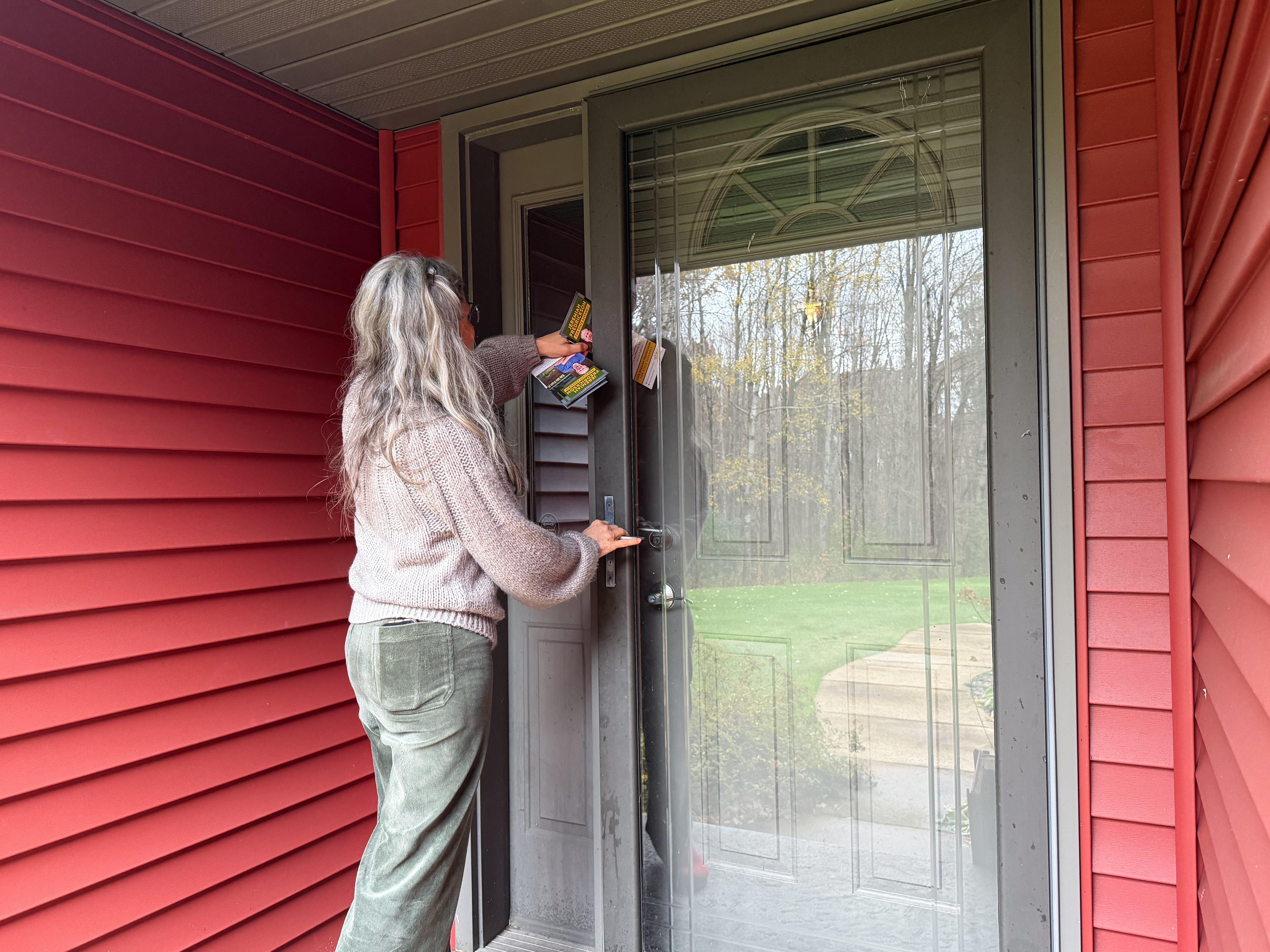
At one door, an older man with white hair looked down at the pamphlet Serrano — the Democratic volunteer for Cooke and Fredrickson — was holding. “You can keep that,” he replied. “I’m not voting for them. No way in hell.”
Van Orden, the Wisconsin Republican racing to hold his seat against Cooke, is skeptical his district’s voters will swing back toward Democrats. That’s despite high prices and Trump’s current unfavorability.
The retired Navy SEAL rode in on his Harley-Davidson motorcycle to the Boon Docks bar as part of a multi-day district tour. After greeting patrons, he told POLITICO in an interview that Cooke is a “flat-out socialist.” He dismissed Sanders’ draw, saying that “voters here hate career politicians.”
“Is it politically convenient that we’re fighting with the Iranians now? The answer is no,” Van Orden said. “I don’t want gas prices to go up. I also don’t want my grandkids fighting the Iranians … 50 years from now.” But he’s counting on Trump voters to turn out for him.

Across the bar, Deb Bork, who’s in her 70s and lives up the road in the small town of Independence, said she was sticking with Van Orden and Trump, regardless of the “hardship” of higher gas prices, saying the war was a blip compared to the length of other U.S. wars.
She still trusts Trump.
“He feels it’s in the best interest of our country to protect us,” she added. “For so long we’ve been out there protecting everybody else and forgetting about the people that live here.”
Leave a Reply